
Present at the signing ceremony was the Taliban's rarely seen Deputy Prime Minister Mullah Abdul Ghani Baradar, who lost out in a power struggle last year to be prime minister.

While the United States is terming the arrest of Mullah Abdul Ghani Baradar, Afghan Taliban No 2, as a big success that could provide 'a wealth of information,' it sounds strange to many that the arrested militant commander was sacked from his post by the Taliban central shura well before from his arrest.
Top Taliban commander Mullah Baradar's arrest in a joint US-Pakistan operation does not mean that Pakistan is moving against the militants and may be seen as a key strategy of the country aimed at maintaining influence on its "western flank", a US think tank said on Monday.

India is navigating a complex diplomatic landscape, attempting to balance its 'forever honeymoon' with the Israel-UAE-Bahrain axis against its historical ties with Iran, as evidenced by recent high-level visits and evolving geopolitical realignments in the Middle East, observes Ambassador M K Bhadrakumar.

Abdul Ghani Baradar, the Taliban leader freed from a Pakistani jail on the request of the US less than three years ago, has emerged as an "undisputed victor" of the 20-year war in Afghanistan, according to a British media report.
Pakistan may release top Afghan Taliban commander Mullah Abdul Ghani Baradar to boost reconciliation efforts with militants in Afghanistan and to play a larger role in the endgame in the neighbouring country.

Pakistan on Friday announced it will release former Afghan Taliban deputy chief Mullah Abdul Ghani Baradar on Saturday, meeting a long-standing demand of Afghan President Hamid Karzai to advance peace efforts in the war-ravaged country.
Together with US sanctions, the new action prohibits any financial transaction of these terror leaders in member countries of the United Nations, which is likely to put pressure on Pakistan to initiate operation against the group

'TTP has vowed to take revenge for the attacks that Pakistan is carrying out against Afghanistan.' 'To diminish this threat, Pakistan is hitting Afghanistan hard.'
The US is pushing for the transfer of captured Taliban commander Mullah Abdul Ghani Baradar to an America-run prison in Afghanistan, apparently frustrated by his silence during interrogation by Pakistani investigators.
He was arrested as part of an ongoing crackdown on the "Quetta Shura" or council of the militants led by Mullah Muhammad Omar, the elusive chief of the Afghan Taliban.

Pakistani authorities agreed during talks with Afghan peace negotiators toc release several Afghan Taliban prisoners to give a push to Kabul's troubled reconciliation process, according to a media report.
Amid deepening concerns in China over the regrouping of the ETIM, blamed by Beijing for all the violent attacks in its volatile Xinjiang province and elsewhere in the country, Foreign Minister Wang Yi met Mullah Baradar at Tianjin and sought to prevail on him to build a 'positive image and establish a broad and inclusive political structure that suits Afghanistan's national realities'.

'The unexpected turn of events and assertion of sovereignty by the Taliban has baffled the Pakistan security establishment.'
A Pakistani court barred the government from extraditing five Afghan Taliban leaders captured in the country, including Mullah Baradar, and asked the administration to explain its position in the matter on Friday.
Pakistan on Saturday released former Afghan Taliban deputy chief Mullah Abdul Ghani Baradar, meeting a long-standing demand of Afghanistan President Hamid Karzai to advance peace efforts in the war-ravaged country.
In a major success, a top militant commander considered to be a close aide of elusive Afghan Taliban chief Mullah Mohhamad Omar was captured from Pakistan's port city of Karachi.Mullah Baradar was captured from Karachi in a joint raid by personnel of the Inter-Services intelligence and the Central Intelligence Agency. But Taliban spokesperson Zabiullah Mujahid rejected the news, saying, "Baradar has not been arrested; it is a rumour."
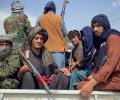
Even though the Taliban has managed to capture Afghanistan and form a government, an internal rift between the faction has started emerging, according to media reports.
The arrest of Baradar, said to be second-in-command to Omar, is a major blow to the Taliban and is being described as a major success to Obama Administration's war against terrorism in the Af-Pak region.
The Pakistan government has turned down United States' request to hand over the Taliban's second-in command Mullah Abdul Ghani Baradar, who was recently captured in Karachi.Pakistan has already made it clear that it would only hand over Baradar to Afghanistan if Kabul requests it to do so.Mullah Baradar is regarded as second only to Mullah Mohammad Omar, Taliban's supreme commander in Afghanistan.
The possible extradition of 12 Afghan Taliban militants, including Taliban No 2 Mullah Abdul Ghani Baradar, arrested by Pakistan has been stalled after the Lahore High Court dismissed petitions regarding the extradition.
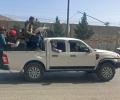
Taliban deputy leader Mullah Baradar on Sunday said that the terror group's victory, which saw all of the country's major cities fall in a week, was unexpectedly swift and had no match in the world.
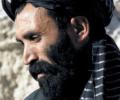
Top Taliban leader Mullah Omar was sheltered by Pakistan's powerful spy agency Inter-Services intelligence after the outfit's leadership fled from Afghanistan in 2001, according to an email received by former secretary of state Hillary Clinton during her tenure.

The Taliban have confirmed that Pakistan's powerful intelligence chief Lieutenant General Faiz Hameed has met its de facto leader Mullah Abdul Ghani Baradar, amidst efforts by the insurgent group to finalise a government in Afghanistan.
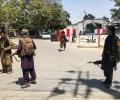
Despite dependence on the ISI for years of sustenance, Taliban leaders may harbour resentment over the ISI's excessive control, notes Rana Banerji, who headed the Pakistan desk at the Research and Analysis Wing.

"Our role (in the Afghan peace process) will remain that of a facilitator and not a leader... allowing the Taliban to open an office in Pakistan will be contrary to our principled position," Prime Minister Nawaz Sharif was quoted as saying by an unnamed aide.

With the Afghanistan government in Kabul approaching Islamabad for help in opening "reconciliation" talks with the Taliban, a Pakistani role in shaping the political landscape in Afghanistan is now an uncomfortable likelihood for New Delhi.
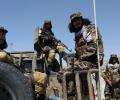
"Now we live in a completely independent Afghanistan. The new government will be announced very soon," said Anaamullah Samangani, a member of the Taliban's cultural commission, reported Tolo News.
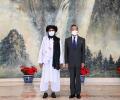
"Due to scheduling reasons, it is inconvenient for China to attend the meeting," Chinese Foreign Ministry spokesman Wang Wenbin told mediapersons.

Hundreds of Afghan protesters, including women, took to the streets of Kabul on Tuesday, chanting 'death to Pakistan' and denouncing Islamabad's interference in Afghanistan and airstrikes by its jets in Panjshir province in support of the Taliban, according to a media report.
"China and the Afghan Taliban have unimpeded and effective communication and consultation," Chinese Foreign Ministry spokesman Wang Wenbin told a media briefing in Beijing.

"The most successful governments in Afghanistan tend to be those who have the biggest tents, which would include all communities and therefore leave all communities satisfied after a point and do not create massive resentments. Now, this is not a government which I would imagine would successfully govern Afghanistan," Dalrymple, the historian said.

Pakistan has granted some concessions to key Afghan Taliban leaders in its custody, including Mullah Omar's deputy Mullah Abdul Ghani Baradar, shifting them to "roomier facilities" and allowing them to make telephonic contact with their families.

If New Delhi finds itself out in the cold in Afghanistan, both the Congress-led UPA and BJP-led NDA have only themselves to blame. Each has been in power for a full decade from 2001, without reaching out to the Taliban, points out Ajai Shukla.
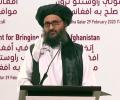
'We never talk about cut of trade ties with any countries. Rumor about this news has been a propaganda. It is not true'
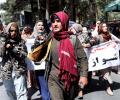
Mullah Muhammad Hassan Akhund is appointed as Prime Minister with two deputies Mullah Abdul Ghani Baradar and Molavi Abdul Salam Hanafi.
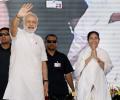
Time's profile of Modi says that in its 74 years as an independent nation, India has had three pivotal leaders -- Jawaharlal Nehru, Indira Gandhi and Modi. "Narendra Modi is the third, dominating the country's politics like no one since them."
The arrest of Mullah Abdul Ghani Baradar, the second-in-command of the Taliban forces operating in Afghanistan, is being seen as a dramatic shift in the policies of Pakistan's Inter Services Intelligence agency, which had hitherto covertly supported some of the organisation's top leaders.But experts warn that by helping the Central Intelligence Agency nab Baradar, the Pakistan government and the ISI will lose the sympathies of Mullah Omer-led Afghan Taliban.

When corruption eats into the vitals of a nation, the State structures decompose and collapse. And when the leadership loses respect of the people, the war is lost, asserts Ambassador M K Bhadrakumar, who played a stellar role in beginning India's systemic dealings in Afghanistan in 1994.
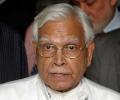
"If I was the foreign minister, I would have had contact with them. I would have gone out of my way and told my intelligence agency to make a contact quietly," former external affairs minister Natwar Singh said.
